Amir Rahmani

Amir Rahmani

Research Associate · Department of Chemical Engineering and Biotechnology · University of Cambridge

I'm Amir, a Postdoctoral Research Associate in the Department of Chemical Engineering and Biotechnology at the University of Cambridge, currently working in Prof. Clemens Kaminski's group in collaboration with the British Antarctic Survey on a UKRI-funded project. My research sits at the intersection of physics, biology, and engineering. I develop advanced super-resolution microscopy tools to study nanoscale cellular behaviour at sub-zero temperatures. I hold a PhD in Physics from the University of Leeds, where I developed the first single-molecule flow cytometry system for applications in adaptive immunotherapy. Prior to my doctoral studies, I trained at world-leading institutes including EMBL Heidelberg and ICFO Barcelona, shaping my passion for cutting-edge imaging science. Beyond research, I enjoy mentoring students, teaching, and engaging with the broader scientific community through conferences and collaborative initiatives.

Outside of the lab, I have a passion for both physical and mental challenges. I train in Kickboxing and Taekwondo, and enjoy staying active through running and football. For a more relaxed but equally competitive fix, you'll often find me at the Ping Pong table or locked in a strategic battle over Chess or Backgammon.

Career Journey

2025 – present
Postdoctoral Research Associate Research
Kaminski Group · Dept. of Chemical Engineering & Biotechnology, University of Cambridge, Cambridge, UK
In collaboration with the British Antarctic Survey
2021 – 2025
PhD in Physics Research
University of Leeds, Leeds, UK · Supervisor: Dr. Aleks Ponjavic
Thesis: Single-molecule imaging flow cytometry
Aug 2025
Preprint: Single-molecule flow cytometry
bioRxiv · with Christie, Truesdale, Thorne, Ponjavic
2025
✈️ Travel Grant — Focus on Microscopy Conference
Focus on Microscopy 2025
Feb 2025
Paper: Active remote focus stabilization in oblique plane microscopy
Biomedical Optics Express · with Nguyen, Ponjavic, Millett-Sikking, Fiolka
2025
🏆 Best Poster Award — Smart Microscopy Symposium
EPFL, Lausanne, Switzerland
2024
🎓 JCS-FocalPlane Training Grant
The Company of Biologists
Apr 2024
Paper: Astigmatism-based active focus stabilisation (PiFocus)
Optics Express · with Cox, Achary, Ponjavic
2021
🎓 EPSRC Doctoral Training Studentship
Engineering and Physical Sciences Research Council · University of Leeds
2020
Research Trainee Research
2019
Research Trainee Research
EMBL Heidelberg · Heidelberg, Germany
Supervisor: Prof. Jonas Ries
2019
BSc in Physics Education

Research Highlights

See all →
Single-molecule flow cytometry thumbnail
Amir Rahmani, Matthew Christie, Amy Truesdale, James Thorne, Aleks Ponjavic
bioRxiv · 2025
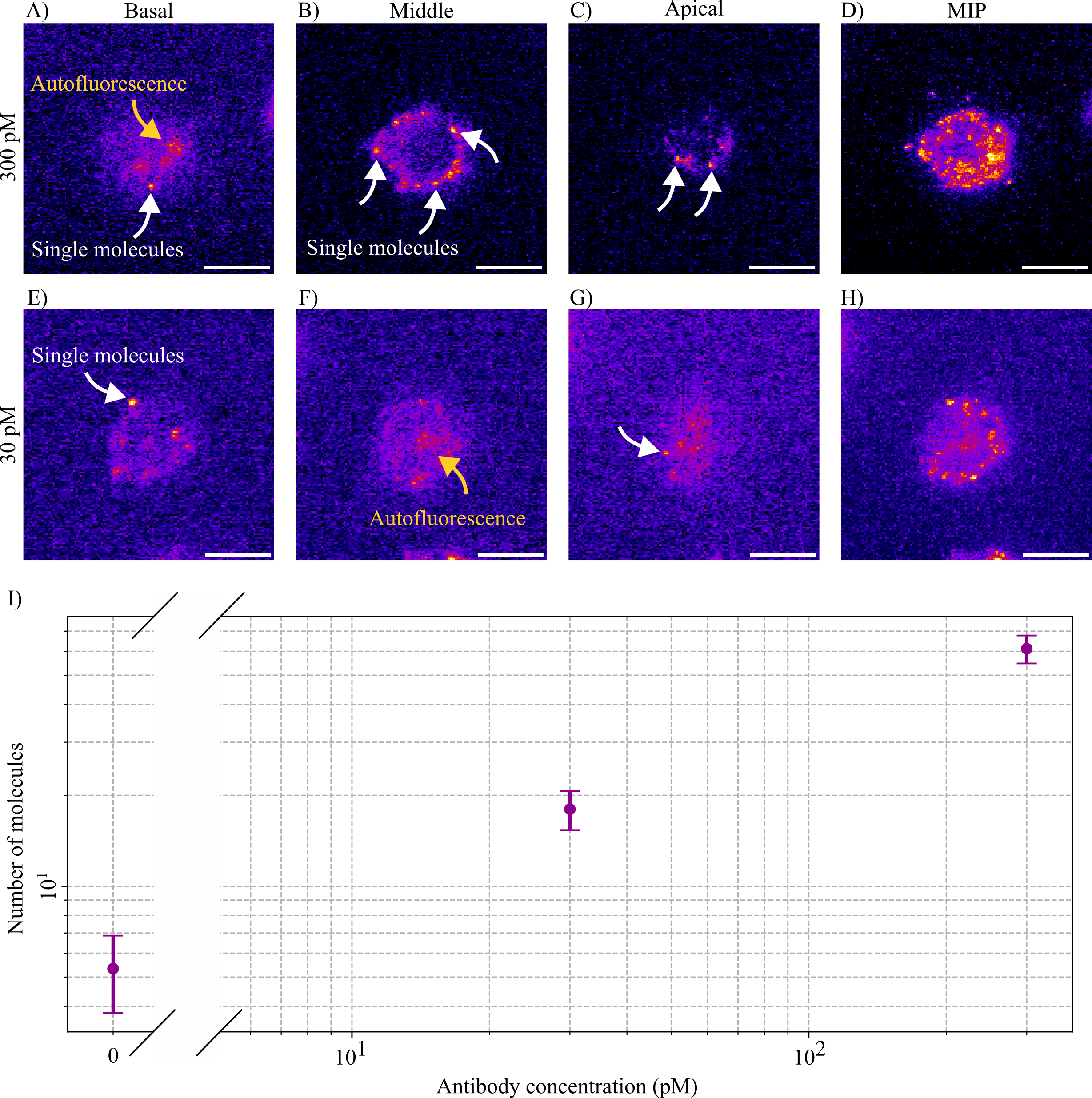
Flow cytometry (FC) is a powerful tool for high-throughput characterisation of cell populations, yet its ensemble fluorescence detection and the autofluorescence of cells impose a sensitivity limit of ∼100-1,000 fluorophores per cell. This precludes detection of low-abundance proteins and weak signalling events with biological importance and therapeutic potential. We introduce single-molecule Flow Cytometry (smFC), integrating high-numerical aperture oblique plane microscopy (OPM) with microfluidics to achieve optical sectioning and photon collection efficiencies suitable for single-molecule detection on flowing cells. Using super-bright, large Stokes shift fluorophores, smFC can detect labelled membrane proteins on cells with digital precision down to ∼2 molecules per cell, compared to an unlabelled control. This represents an improvement in the detection limit of 10- to 80-fold depending on the probe. We apply smFC to quantify the distribution of the membrane receptor c-kit in triple-negative breast cancer cells with unprecedented sensitivity. This revealed a previously unidentified distribution of 60% c-kit negative cells and 40% with low-abundance but heterogenous (1-200 mol/cell) surface distribution that is undetectable by conventional FC. These results establish smFC as a robust platform for high-throughput, quantitative single-molecule analysis in cell populations, opening new avenues for detecting rare biomarkers and quantifying the presence of low-abundance membrane proteins and targetable surface molecules with digital precision.
Astigmatism-based focus stabilisation thumbnail
Amir Rahmani, Tabitha Cox, Akhila Thamaravelil Abhimanue Achary, Aleks Ponjavic
Optics Express · 2024
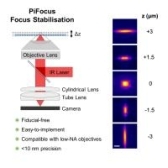
Focus stabilisation is vital for long-term fluorescence imaging, particularly in the case of high-resolution imaging techniques. Current stabilisation solutions either rely on fiducial markers that can be perturbative, or on beam reflection monitoring that is limited to high-numerical aperture objective lenses, making multimodal and large-scale imaging challenging. We introduce a beam-based method that relies on astigmatism, which offers advantages in terms of precision and the range over which focus stabilisation is effective. This approach is shown to be compatible with a wide range of objective lenses (10x-100x), typically achieving <10 nm precision with >10 μm operating range. Notably, our technique is largely unaffected by pointing stability errors, which in combination with implementation through a standalone Raspberry Pi architecture, offers a versatile focus stabilisation unit that can be added onto most existing microscope setups.